
Global Trade Disruption Hits Steelmaking Raw Materials
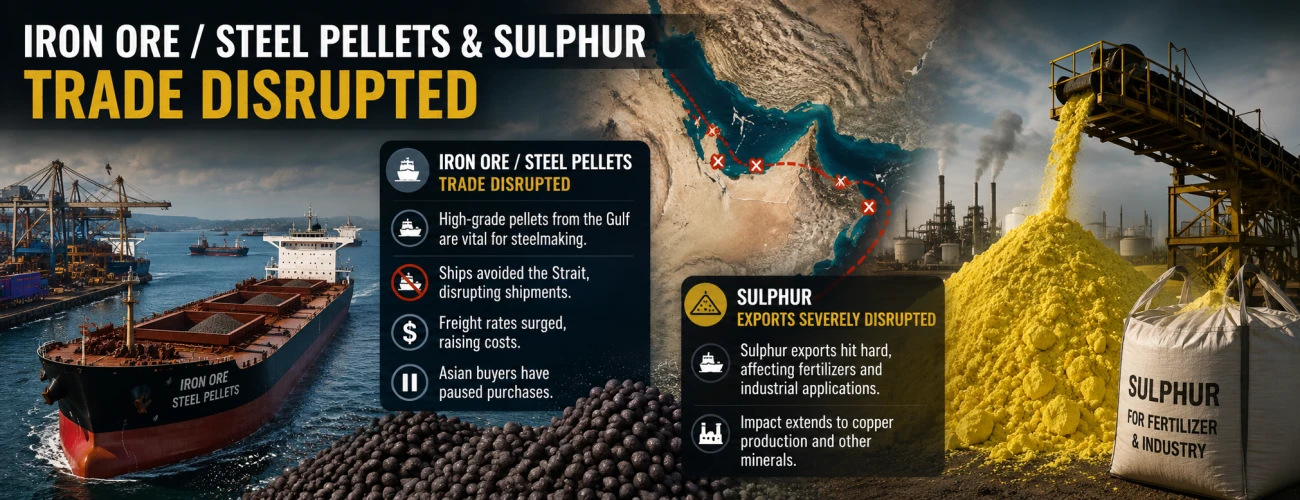
The global trade of iron ore, steel pellets and sulphur has come under pressure as shipping uncertainty across key Middle East routes continues to affect commodity flows.
For the steel industry, the main concern is not only the availability of iron ore, but also the reliability of freight, delivery schedules and alternative shipping routes. Iron ore pellets, direct reduced iron, hot-briquetted iron and other steelmaking raw materials are highly dependent on predictable logistics. When vessels avoid strategic chokepoints or face higher insurance and freight costs, buyers often pause spot purchases until pricing and delivery risk become clearer.
This creates a short-term squeeze in the steel raw material supply chain, especially for Asian buyers who rely on seaborne cargoes.
Companies monitoring iron ore, steel pellets and other metallic raw materials can explore related supply opportunities through the Iron Products Listing Page.
Why Iron Ore and Steel Pellets Matter
Iron ore remains the foundation of global steel production. Steelmakers use different raw materials depending on production route, including:
- Iron ore lump
- Iron ore fines
- Iron ore pellets
- Pellet feed
- Direct reduced iron inputs
Steel pellets are especially important for modern steelmaking because they offer more consistent quality, better furnace performance and improved efficiency compared with some lower-grade raw materials.
High-quality pellets are often traded internationally and depend heavily on stable freight routes. When shipping becomes uncertain, buyers may delay procurement decisions or shift toward alternative sources, even if demand from steel mills remains structurally strong.
Freight Risk and Asian Buyer Behavior
Shipping disruption can affect steel raw materials in several ways.
First, suppliers may face difficulty securing vessel space. Second, freight rates can rise quickly when routes become longer or riskier. Third, buyers may hesitate to close new deals if they are unsure whether cargo can arrive on time or within the expected cost range.
This is especially relevant for Asian steelmakers, where import flows of iron ore, pellets and related raw materials are closely tied to delivery reliability.
In these conditions, procurement teams tend to move from price-only decisions toward supply-chain risk management. Instead of asking only “what is the lowest price?”, buyers increasingly ask:
- Can the supplier secure freight?
- Is the cargo route reliable?
- Can delivery timing be guaranteed?
- Are inspection and documents available?
- Is there an alternative loading route?
This shift is important for both iron ore suppliers and buyers in 2026.
Sulphur Disruption Adds Pressure to Metal Processing
While iron ore and steel pellets are affected mainly through freight and logistics, sulphur disruption creates a different type of risk.
Sulphur is a key raw material used to produce sulphuric acid, which is essential in several mineral processing routes. In copper and nickel production, sulphuric acid is widely used in leaching and refining operations.
This means sulphur shortages can indirectly affect the production of important metals, especially in regions that depend heavily on imported sulphur.
The African Copperbelt is one of the most exposed regions because copper and cobalt producers in the DRC and Zambia rely on sulphur and sulphuric acid availability for parts of their processing chain.
For companies active in copper sourcing, this makes supply-chain visibility increasingly important. Related copper materials and supply opportunities can be reviewed through the Copper Products Listing Page.
Impact on Copper, Nickel and Battery Metals
The sulphur issue is not limited to copper. Nickel producers, especially those using acid-leaching processing routes, may also face pressure when sulphur supply becomes tight.
This is important because nickel, copper and cobalt are all connected to global energy transition industries, including:
- Electric vehicles
- Battery production
- Renewable energy infrastructure
- Power grids
- Industrial electrification
If sulphur supply becomes expensive or difficult to secure, downstream metal producers may face higher costs, production delays or reduced output.
What This Means for Buyers and Suppliers
The disruption highlights a broader lesson for the mineral trade market: price is no longer the only risk.
For buyers, the key priorities are now:
- Reliable shipment routes
- Verified suppliers
- Flexible delivery terms
- Third-party inspection
- Alternative sourcing regions
For suppliers, this environment creates opportunities to stand out by offering:
- Clear origin and loading details
- Export documentation
- Inspection support
- Flexible FOB / CIF terms
- Consistent monthly supply capability
In volatile markets, suppliers who can prove reliability may gain an advantage over lower-priced but uncertain offers.
Broader Metallic Minerals Market Outlook
The pressure on iron ore, steel pellets and sulphur shows how connected the global minerals market has become. A disruption in one shipping corridor can affect steelmaking raw materials, fertilizers, copper processing, nickel production and battery metals at the same time.
This is why buyers and industrial companies are paying more attention to structured sourcing, verified suppliers and diversified supply chains.
Explore wider metallic mineral opportunities through the Metallic Minerals Listing Page.
Conclusion
The disruption in iron ore, steel pellets and sulphur trade is more than a short-term freight issue. It reflects a deeper change in how global buyers evaluate mineral supply chains.
Iron ore and pellets remain essential for steel production, while sulphur continues to play a critical role in copper, cobalt and nickel processing. As freight costs, route risks and raw material availability become more unpredictable, companies that build flexible sourcing strategies will be better positioned in the global metals market.
For 2026, the key takeaway is clear: reliable logistics, verified supply and diversified sourcing are becoming as important as price.








.j_s_thumb.webp)